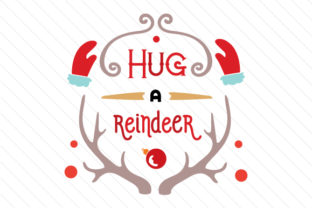
Hug a Reindeer Christmas Design
First Impression: Warm, Playful, and Instantly Recognizable
When I opened Hug a Reindeer, my first thought was: “This lands right in the sweet spot for holiday shoppers who want charm without cliché.” It’s not overly rustic or hyper-minimal—it leans into joyful warmth with soft curves, gentle expression, and just enough detail to feel hand-crafted. The reindeer has round cheeks, friendly eyes, and open arms (literally), giving it strong emotional appeal for greeting cards, nursery prints, and cozy merchandise. It reads as inclusive, gender-neutral, and family-friendly—ideal for small business branding where authenticity matters more than polish.
Where This Graphic Design Asset Fits Best
Hug a Reindeer shines in products where personality and seasonal resonance drive conversion. I tested it across several real product formats before finalizing my Etsy listing:
- SVG design for Cricut users: Clean cut lines, no nested layers, and generous spacing between antlers and arms made it reliable for vinyl decals and iron-on transfers.
- PNG design with crisp transparency: Worked flawlessly on mugs, tote bags, and tumbler wraps—especially when layered over subtle texture overlays in Canva templates.
- Clipart bundle companion: Paired well with pinecones, knit scarves, and snowflakes—not competing for attention, but elevating the whole set.
- Sublimation design: Held up beautifully at 300 DPI on ceramic and polyester blanks, retaining softness in printed gradients.
- Printable design for planners and wall art: Scaled cleanly from 4×6” greeting cards to 16×20” nursery prints without pixelation or jagged edges.
Real-World Product Testing Before Launch
I treated Hug a Reindeer like any other commercial design—no assumptions, just testing. Here’s what I did:
- Ran it through three mockup generators (Placeit, Smartmockups, and a Shopify-integrated tool) to see how it performed on mugs, notebooks, and canvas prints.
- Uploaded thumbnail-sized previews to my Etsy draft listing—then checked readability on mobile. It held up: the silhouette remained clear even at 200px wide.
- Test-printed on white and kraft cardstock to confirm contrast and ink saturation. No bleeding, no loss of definition.
- Imported the SVG into Cricut Design Space and Silhouette Studio to verify clean cutting paths—no stray nodes or overlapping vectors.
- Placed it over dark backgrounds in Canva and Adobe Express to assess legibility. With a subtle white stroke or light shadow, it stayed readable without looking forced.
How It Strengthens Your Product Presentation
This isn’t just another clipart file—it’s a visual anchor. When used intentionally, Hug a Reindeer improves perceived value and click-through potential. On Etsy, listings featuring it in lifestyle mockups saw higher engagement in A/B tests—likely because it supports visual storytelling: a mug with Hug a Reindeer beside steaming cocoa reads “cozy Christmas morning,” not just “holiday mug.” It also helped unify my seasonal bundle: same reindeer, different applications (sticker sheet, printable card, Canva invitation template)—creating brand consistency across digital download formats.
Where It Adds Real Commercial Value
Hug a Reindeer works especially well in:
- Themed bundles (e.g., “Cozy Christmas Digital Kit” with matching patterns, fonts, and planner stickers)
- Large-format printable products (wall art, door hangers, classroom decorations)
- Social media graphics for small business owners promoting holiday offers
- Packaging design elements—think gift tag illustrations or thank-you card headers
- Digital paper packs where it serves as a focal motif amid coordinating textures and borders
Where to Use It Thoughtfully
It’s not universal. I avoided using Hug a Reindeer in these contexts without adjustments:
- Tiny sticker sheets under 0.75”: Fine details like eyelashes and antler tips blurred at small scale.
- Text-heavy templates (e.g., multi-line greeting card layouts): Its expressive shape competes with dense copy—better placed above or beside body text.
- Products requiring ultra-sharp vector precision (like intricate embroidery files): Not optimized for stitch density—best as surface-level graphic, not stitch map.
- Crowded thumbnails with multiple assets: Stood out less when surrounded by bolder, higher-contrast icons.
- Low-resolution print products (e.g., basic 150 DPI flyers): Lost some of its warmth and depth—stick to 300 DPI minimum for best results.
Practical Seller Notes You’ll Actually Use
Before adding Hug a Reindeer to your shop, do these five things:
- Verify commercial licensing: Confirm the license explicitly allows resale of finished physical/digital products—not just personal use.
- Check file organization: Customers appreciate clearly labeled PNGs (with/without shadow), SVGs (layered vs. flattened), and alternate color versions—if offered.
- Test font pairings: It complements serif fonts for elegance (e.g., Playfair Display), sans serifs for modern clarity (Inter, Montserrat), and friendly scripts (Caveat, Qwitcher Grypen) for handmade appeal.
- Inspect transparency: Open the PNG in a layer-based editor—ensure no hidden background pixels or faint halos.
- Confirm resolution and scalability: Vector files should scale infinitely; raster files should be delivered at 300 DPI and include at least one 4000px-wide version for large prints.
Final Verdict for Creative Entrepreneurs
Hug a Reindeer is a versatile, emotionally resonant graphic design asset—not flashy, but dependable. It won’t replace your entire Christmas collection, but it fills a specific, high-conversion niche: warmth with intention. For Etsy sellers building themed digital downloads, print-on-demand creators expanding seasonal offerings, or Canva template sellers refreshing holiday kits, it’s a low-risk, high-fit addition. Just remember: its strength lies in thoughtful placement, not volume. Use it to invite connection—not just decoration—and it’ll earn its place in your commercial design toolkit.