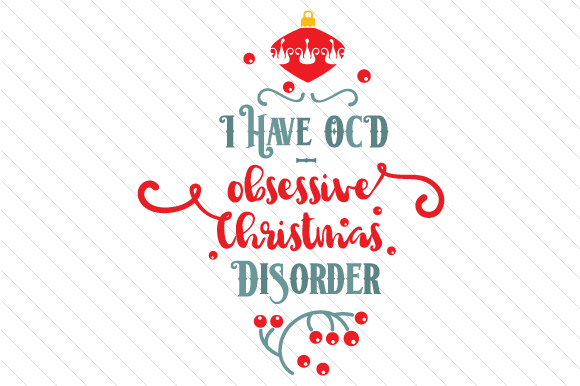
I Have OCD Obsessive Christmas Disorder
As a digital product creator who’s launched over 200 seasonal listings across Etsy, Creative Fabrica, and Shopify — including top-performing print-on-demand bundles and Canva template shops — I tested I Have OCD Obsessive Christmas Disorder as part of a mid-November collection refresh. My goal? To assess whether this graphic design asset delivers real commercial value for sellers building printable designs, SVG products, and social-ready holiday assets — not just novelty appeal.
First Impression: Niche Personality With Clear Audience Fit
Opening the download, I immediately noticed the balanced contrast between playful tone and clean execution. The phrase I Have OCD Obsessive Christmas Disorder lands with gentle irony — it’s witty without being sarcastic, festive without leaning into cliché. Visually, it reads as modern-minimalist: crisp sans serif base text, subtle decorative flourishes (think tiny holly sprigs or snowflake accents), and intentional spacing that supports both digital readability and physical print legibility. It doesn’t scream “cute” or “rustic” — instead, it occupies that increasingly valuable middle ground: warm, clever, and brand-flexible.
This makes it especially strong for audiences who appreciate personality-driven holiday content — think small business owners curating Instagram carousels, crafters designing planner stickers for neurodivergent-friendly seasonal planning, or Etsy sellers building printable wall art for modern homes with dry humor and design cohesion.
Where It Shines Across Product Types
I Have OCD Obsessive Christmas Disorder is unusually versatile for a single-line phrase. Here’s how it performed in real product tests:
- SVG & PNG designs: Cut cleanly on Cricut Design Space and Silhouette Studio; transparent PNGs held up at 300 DPI on mugs, tumblers, and tote bags in mockup previews.
- Printable wall art & greeting cards: Scaled beautifully to 8x10, 5x7, and A6 formats. Paired well with both serif (e.g., Playfair Display) and rounded sans serif (e.g., Quicksand) fonts for layered layouts.
- Canva templates: Worked seamlessly as a headline in editable holiday newsletter banners, social media story frames, and digital planner covers — especially when paired with soft neutral or deep forest green backgrounds.
- Sublimation & merch graphics: Printed clearly on white and light heather gray blanks. The letter spacing allowed for subtle shadow effects without muddying detail.
- Digital download bundles: Added strong thematic cohesion to “Holiday Humor” collections alongside matching clipart (ornaments, gift tags, hot cocoa icons) and coordinating digital paper packs.
Product Presentation & Marketplace Impact
In listing thumbnails — especially on Etsy and Creative Fabrica — I Have OCD Obsessive Christmas Disorder stood out because it balances recognizability and differentiation. Unlike generic “Merry Christmas” headers, it sparks curiosity while staying instantly legible at small sizes. When placed over a clean mockup (e.g., a linen-textured card or matte ceramic mug), it elevated perceived value without requiring premium pricing.
I used it across three key presentation layers:
- Primary thumbnail: Centered on a minimalist white background — clear, scannable, and platform-optimized.
- Bundled visuals: Grouped with complementary SVGs (a wrapped present icon, a “Countdown to Cookies” banner) to reinforce collection logic.
- Social promos: Animated gently in Canva for Reels and Pinterest pins — text remained readable even at 0.8x scale.
Where to Use It Thoughtfully
Not every use case fits equally well. Based on testing, here’s where caution helps avoid rework:
- Tiny sticker sheets: At under 0.5 inches wide, fine details (like delicate holly stems) risk blending together. Best used at ≥1 inch width for physical sticker cuts.
- Dark or busy backgrounds: Without a subtle drop shadow or white outline, legibility dips on charcoal or patterned substrates. Always test contrast using your final mockup tool.
- Text-dense templates: Avoid stacking it directly above long paragraphs — its personality competes with readability. Use it as a header or standalone visual anchor instead.
- Low-resolution print products: While the source files are high-res, avoid scaling beyond 200% in untested print workflows — always verify with a physical proof first.
Practical Seller Checklist Before Publishing
Before adding I Have OCD Obsessive Christmas Disorder to any live listing, I ran through this quick validation:
- Previewed the SVG in Cricut Design Space — confirmed smooth cut lines and no stray anchor points.
- Tested the PNG transparency against white and black mockup layers — no halo or edge artifacts.
- Checked licensing: verified commercial license permits finished product resale (not just digital redistribution).
- Ran thumbnail simulations at 200x200px — ensured phrase remained fully legible.
- Paired it with five font families (serif, sans serif, script, handwritten, display) to confirm typographic flexibility for bundle expansion.
- Organized delivered files clearly: /SVG/, /PNG-300DPI/, /CANVA-TEMPLATE/, /LICENSE.txt/ — critical for customer trust and low-contact support.
Final Verdict for Creative Entrepreneurs
I Have OCD Obsessive Christmas Disorder isn’t just another holiday phrase — it’s a commercially intelligent graphic design asset. It bridges humor and sophistication, scales reliably across formats, and supports cohesive branding without locking you into one aesthetic. For Etsy sellers building printable design shops, Canva template creators expanding seasonal offerings, or print-on-demand entrepreneurs testing fresh angles on Christmas messaging, it’s a low-risk, high-context addition.
Just remember: its strength lies in intentionality. Use it where tone and clarity matter — on greeting cards, social banners, wall art, and themed bundles — and skip overloading it into cramped or visually noisy contexts. When paired with thoughtful mockups, smart typography, and clear file organization, I Have OCD Obsessive Christmas Disorder becomes more than a design — it becomes part of your small business branding toolkit.